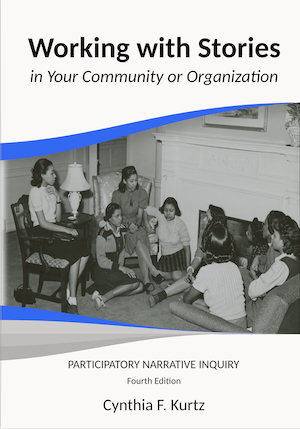
Working with Stories is a textbook series that can help your group, community, or organization share stories with each other to discover insights you can use, get along better, and make better decisions together.
The rewritten fourth edition of Working with Stories explains how to use Participatory Narrative Inquiry to help your group, community, or organization share and make sense of stories to understand each other and to make collective sense of complex issues and situations.
ISBN: 978-0-9913694-4-7
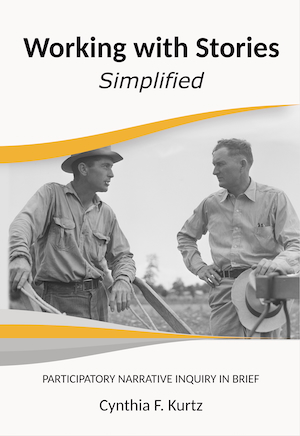
Working with Stories Simplified covers the same topics as Working with Stories, but more quickly and simply. Read it if you prefer a shorter book or want a cheat-sheet version of the longer textbook.
ISBN: 978-0-9913694-6-1
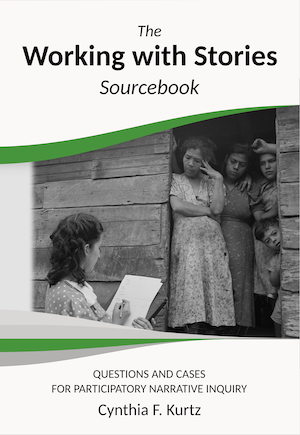
The Working with Stories Sourcebook contains 50 sets of questions you can use and adapt in your PNI projects, plus 60 case studies of real PNI projects that happened in real commmunities and organizations.
ISBN: 978-0-9913694-8-5
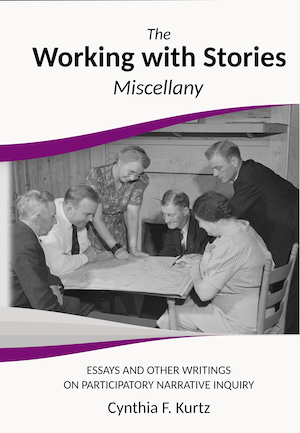
The Working with Stories Miscellany contains 40 essays and other pieces of writing about PNI, stories, and story work.
ISBN: 979-8-9989174-0-0
Participatory Narrative Inquiry (PNI) is a form of Participatory Action Research in which groups of people share and work with their stories of personal experiences to understand each other and to make collective sense of complex issues and situations.
PNI focuses on the profound consideration of values, beliefs, feelings, and perspectives through the recounting and interpretation of lived experience. Elements of fact, truth, evidence, opinion, and argument may be used as material for sensemaking in PNI, but they are always used from a perspective and to gain perspective.
When we share stories with each other, we enter into an ancient social ritual that helps us to reveal our values, beliefs, and feelings in an oblique, indirect way that is (somewhat) safer than direct declaration. Stories also help us solve problems. They help us make sense of what has happened and how we feel about it, whether we are telling stories or listening to them.
PNI builds on these ancient rituals and purposes to help groups, communities, and organizations learn and grow together. Asking people to share stories (with you and with each other) invites reflection, conveys respect, and opens doors of understanding.
I'm Cynthia F. Kurtz. I'm a consultant, researcher, writer, coach, and software developer. I have been helping communities and organizations work with their stories since 1999.
You can read about my background, my consulting services, and my other publications on my web site, cfkurtz.com.
If you have a budget, you can take one of my paid online courses (the PNI Practicum).
At the moment I am not yet ready for new course sign-ups, but I will be ready soon.
You can send me questions about the paid courses at cfkurtz@cfkurtz.com.
If you don't have a budget, you can use the PNI Practicum
course materials (yourself) for free. You can also
use my free PNI project software (NarraFirma) and
my free story-sharing game (Narratopia).
You are also invited to join our peer-support group (Participatory Narrative Practitioners), which meets quarterly to talk shop about participatory story work of all kinds.
Yes it is. I'm not a wealthy person, but I care a lot about helping people get along and build a better world.
If you can afford it, please consider making a donation to help me keep doing this work.